Who's Funding Scott Wiener, and What Do They Want?
A guide to the donors backing the front-runner in California's June 2 primary to replace Nancy Pelosi.
Coverage of San Francisco politics often treats "tech money" as a monolithic thing. That treatment has always struck me as overly simplistic, given the variety of agendas these donors are pursuing. On the issue of AI safety alone, some tech money is funding Wiener's bills while other tech money has spent $125 million trying to defeat them. Y Combinator's Garry Tan supports Wiener for having "delivered on the hard stuff," while Elon Musk has called Wiener an "utter scumbag". I wanted to look past the "tech money" label to understand the characters behind the money and what they want from Wiener.
The Federal Election Commission (FEC) publishes itemized records of contributions to every federal campaign and PAC. For this piece, I pulled the FEC filings on Scott Wiener's donors to figure out who the major givers are and what they're hoping to get from him in Washington. From there I could decide whether those agendas are things I support, or things I disagree with.
Where the money comes from
According to the FEC filings, Wiener has raised more money than any other candidate in the field. He has raised $3.95 million through May 13, plus another $1 million in outside super-PAC support either spent on his behalf or formally pledged. That money comes from four overlapping groups: the Abundance backers, AI Safety donors, his longtime professional San Francisco base, and California tech wealth opposing new wealth taxes.
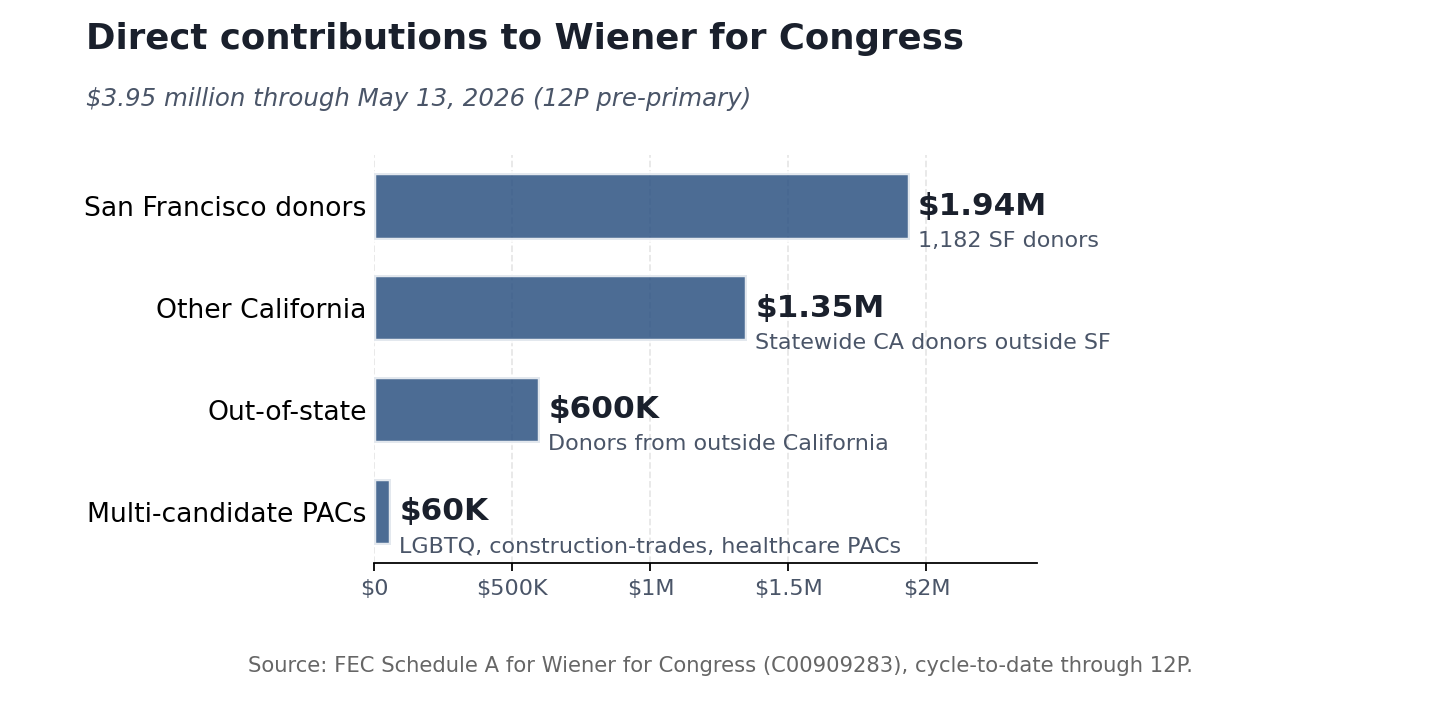
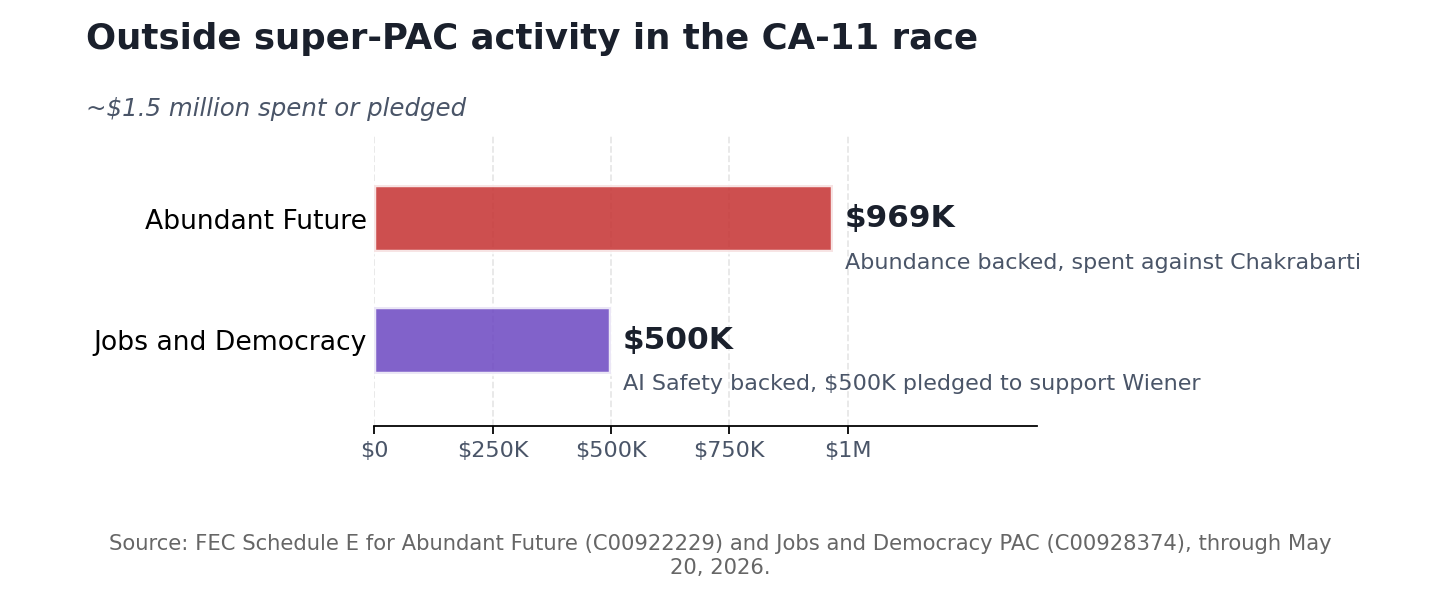
The Abundance backers want federal policy that makes it easier to build housing, energy, and infrastructure. The AI Safety donors want Wiener's California AI safety bill at the federal level. The SF base wants Wiener to carry his fifteen-year record on LGBTQ+ rights, transit, and abortion to Washington. The anti-wealth-tax tech executives support his continued opposition to wealth-tax measures at the California and federal level.
The Abundance coalition (Abundant Future)
"Abundance" is a brand-name political position that has emerged over the past two years, popularized by Ezra Klein and Derek Thompson's best-selling book Abundance. The book argues progressive politics has failed by protecting existing institutions instead of enabling new construction of housing, energy, and infrastructure.
In San Francisco, Abundance has supported YIMBY housing policy, recall campaigns against progressive supervisors, and moderate Democrats against progressive challengers. The movement is led by organizations like California YIMBY, SPUR, and Abundant SF. They believe new supply of housing, energy, and infrastructure will bring prices down, and that government should get out of its own way to deliver it.
Who are the Abundance donors?
According to the FEC filings, the named donors at Abundant Future include the following, with several joining during the pre-primary April-to-May window:
| Donor | Affiliation | Amount |
|---|---|---|
| Chris Larsen | Co-founder, Ripple | $100,000 |
| Michael Moritz | Sequoia Capital partner; chairman, SF Standard (gave via HRTG Partners family office) | $100,000 |
| Laura Skelton Yakovenko | Wife of Solana co-founder Anatoly Yakovenko (Solana is a cryptocurrency platform) | $100,000 |
| John Wolthuis | Co-founder, Twilio; California YIMBY board member | $50,000 |
| Jeremy Stoppelman | CEO, Yelp | $35,000 |
| Garry Tan | CEO, Y Combinator | $25,000 |
| Brian Singerman | Quiet Capital; former Founders Fund partner | $25,000 |
| Jeremy Liew | Lightspeed Venture Partners | $20,000 |
| Dede Wilsey | SF philanthropist and FAMSF chair emerita; great-granddaughter of Dow Chemical founder Herbert Henry Dow; registered Republican | $7,000 |
Most of these donors have been co-funding YIMBY infrastructure in California for nearly a decade, including California YIMBY, the SF Housing Accelerator Fund, and PACs that backed Daniel Lurie's 2024 mayoral win. Wiener is the most prominent YIMBY legislator in California, and what they want federally is more of what he's done in Sacramento.
Abundant Future also took two PAC-to-PAC transfers on April 13, 2026: $250,000 from Smart Justice California Action Fund and $500,000 from Public First Action (PFA). Mission Local first reported on the PFA transfer, which is notable because PFA is the AI Safety coalition's 501(c)(4) vehicle. The same donor pool funds both PFA's pro-Wiener pledge and Abundant Future's anti-Chakrabarti attack mail. The mixing of AI Safety dollars with an Abundance-agenda attack campaign is one of the more unusual money flows in this race.
Anti-Chakrabarti attack mail
Abundant Future is operating as an anti-Chakrabarti PAC. Through the most recent filings (May 20), all $969,517 of its independent expenditures have been negative spending attacking Saikat Chakrabarti, Wiener's closest progressive challenger.
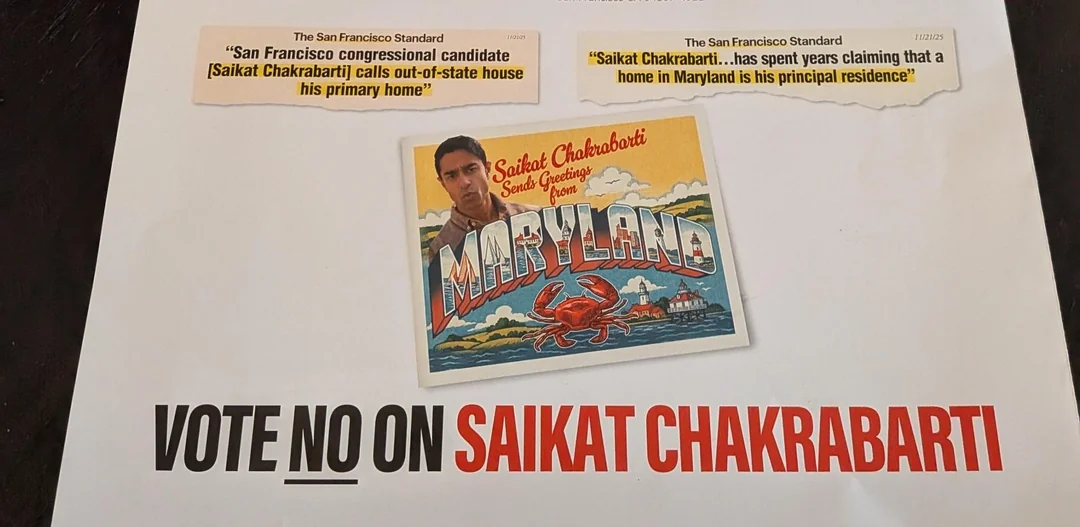
All 14 expenditures went to a single vendor: The Media Company, a political consulting firm in Pacific Heights. The mailers ran roughly weekly from March 18 through May 20, with each mailing costing around $70,000. That is a sustained, planned ten-week negative-mail program against Chakrabarti.
| Disseminated | Vendor | Amount |
|---|---|---|
| Mar 18, 2026 | The Media Company | $65,178.42 |
| Mar 18, 2026 | The Media Company | $65,178.42 |
| Mar 30, 2026 | The Media Company | $70,369.57 |
| Mar 30, 2026 | The Media Company | $70,369.57 |
| Mar 30, 2026 | The Media Company | $70,369.57 |
| Apr 8, 2026 | The Media Company | $70,001.42 |
| Apr 14, 2026 | The Media Company | $71,838.73 |
| Apr 22, 2026 | The Media Company | $70,045.79 |
| Apr 28, 2026 | The Media Company | $70,075.74 |
| May 5, 2026 | The Media Company | $69,756.44 |
| May 13, 2026 | The Media Company | $69,142.85 |
| May 15, 2026 | The Media Company | $69,755.29 |
| May 18, 2026 | The Media Company | $69,142.85 |
| May 20, 2026 | The Media Company | $68,292.20 |
| Total (14 records, all opposing Chakrabarti) | $969,516.86 | |
What's interesting is that Chan is actually the more anti-supply candidate. She has voted against several of Wiener's state upzoning bills as a supervisor, but she is not the one being attacked. Chakrabarti supports federal public housing at scale, which is pro-supply via different mechanisms. Abundant Future's spending is more about defeating the strongest challenger, who has a different approach to housing supply.
Where Abundance falls short
Not everyone thinks the Abundance approach will work. The critique, made consistently by tenant advocates and the housing-justice left, is that supply-side housing functions as "trickle-down housing," with immediate beneficiaries being developers and high-income arrivals. They also worry about displacement and loss of neighborhood character.
Chakrabarti claims that Wiener's housing approach has yet to produce positive outcomes:
Scott Wiener's results on housing:
— Saikat Chakrabarti for Congress (@saikatc) May 23, 2026
❌SF median home price doubled
❌CA homelessness at all-time high
❌SF built fewer homes / year than when Scott started
❌CA housing supply gap unchanged at 3 million units
❌Share of Californians who can buy a home decreased by a third
Even Klein and Thompson themselves have acknowledged shortcomings. On the Ezra Klein Show in April 2026, one year after the book's release, they conceded that Abundance underweighted financing. Even as YIMBY bills pass, high interest rates and rising construction costs mean many projects don't pencil out for developers. The book fails to address the macroeconomic forces that underly new construction.
The AI Safety coalition (researchers + Public First Action)
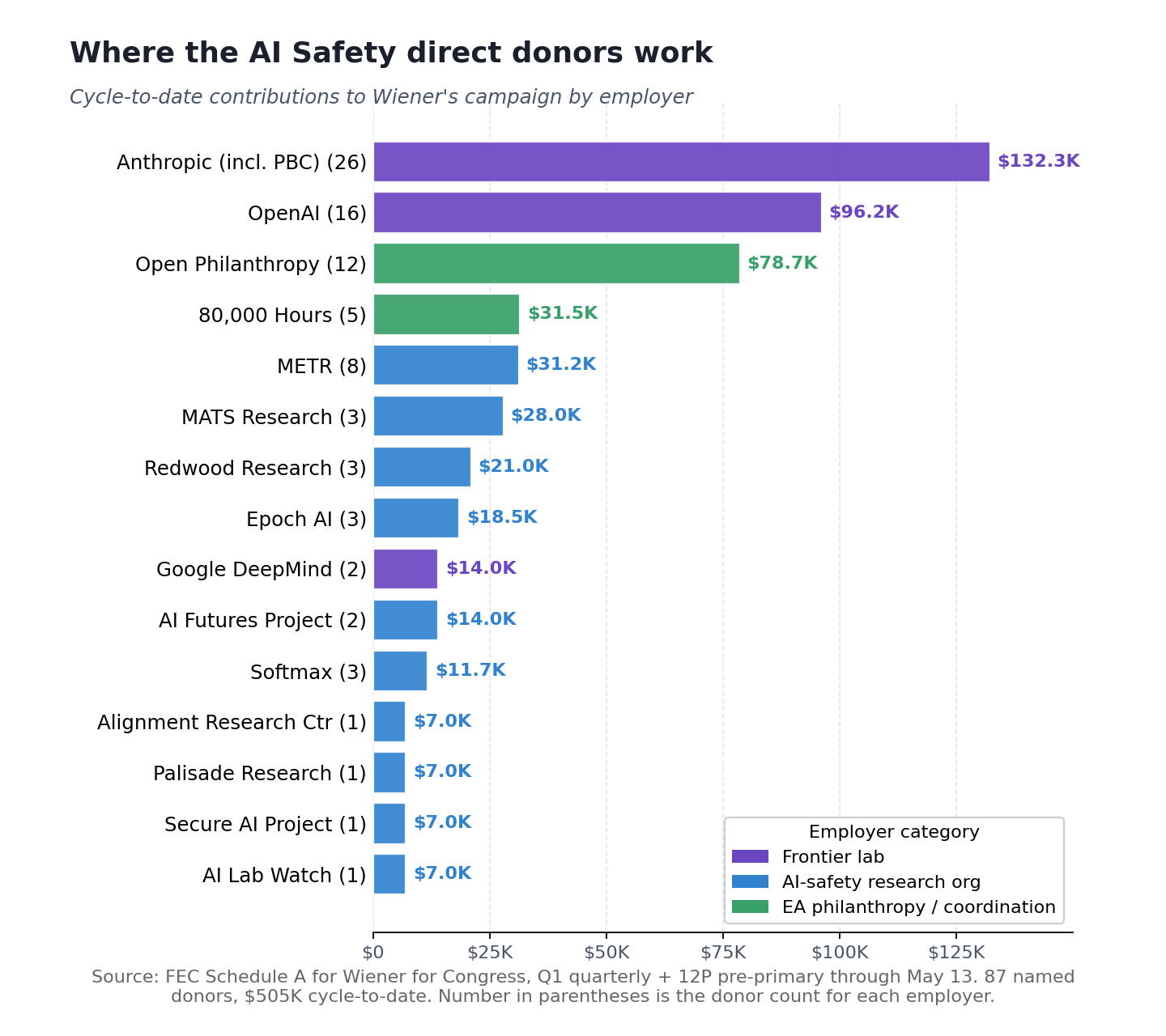
The AI Safety coalition has put more than $1 million directly into the CA-11 primary. While this is "AI money", the AI Safety coalition shares some of the same concerns as the anti-AI crowd. Both worry that corporations are racing to deploy frontier AI without considering the consequences. They believe frontier AI development poses catastrophic risk, and want government to mandate safety testing, set liability for harms, and preserve states' authority to regulate AI without federal preemption.
Anthropic has established itself as the leading voice in this coalition, and its employees are the largest single group of researcher donors to Wiener. Not everyone thinks Anthropic is doing a good job. I attended a PauseAI protest at Anthropic's SF headquarters and wrote about it in March 2026. The protesters demanded a conditional pause on frontier model development, arguing that even labs like Anthropic that publicly back safety legislation are racing too fast.
Who are the AI Safety donors?
Researchers at Anthropic, OpenAI, METR, Redwood Research, MATS Research, Open Philanthropy, 80,000 Hours, and similar organizations have given directly to Wiener, essentially everyone at or near the $3,500 federal max. Named donors include Jan Leike (former OpenAI Superalignment head), Sam Bowman, Evan Hubinger, Luke Muehlhauser, and Daniel Filan.
In addition to individual researchers, Public First Action (a bipartisan policy nonprofit Anthropic donated $20M to in February 2026) has pledged $500,000 to Wiener through its affiliated super PAC, Jobs and Democracy.
What do Wiener's AI Safety bills do?
The AI Safety coalition emerged from the fight over SB 1047, Wiener's AI Safety bill. Wiener introduced SB 1047 in February 2024 as the first serious attempt by any U.S. legislature to regulate frontier AI development. It would have required developers of the largest AI models (those trained with more than $100 million in compute, or capable of specified dangerous behaviors) to test for catastrophic risks before deployment, implement safety protocols, and assume liability for severe harms caused by their systems. The bill passed both houses of the California legislature in August 2024 but was vetoed by Governor Newsom in September. Wiener's follow-up legislation, SB 53 in 2025, narrowed the scope to safety reporting and whistleblower protections for AI lab employees. Newsom signed that one in September 2025. The federal version his AI Safety donors want would adopt the full SB 1047 framework while leaving states free to add their own protections on top.
More AI money is AGAINST bills like Wiener's
While it is often said that "AI money backs Wiener", that framing is an oversimplification. By dollar amount, far more AI money is mobilized against Wiener's policies than supports him.
In August 2025, Andreessen Horowitz, OpenAI president Greg Brockman, and Perplexity launched Leading the Future, a $125 million super PAC built to fight state-level AI safety legislation, the kind Wiener authored. Through its affiliated super PACs, LtF has spent $2.64M attacking Alex Bores in NY-12, the state assemblyman carrying a bill modeled on SB 1047.
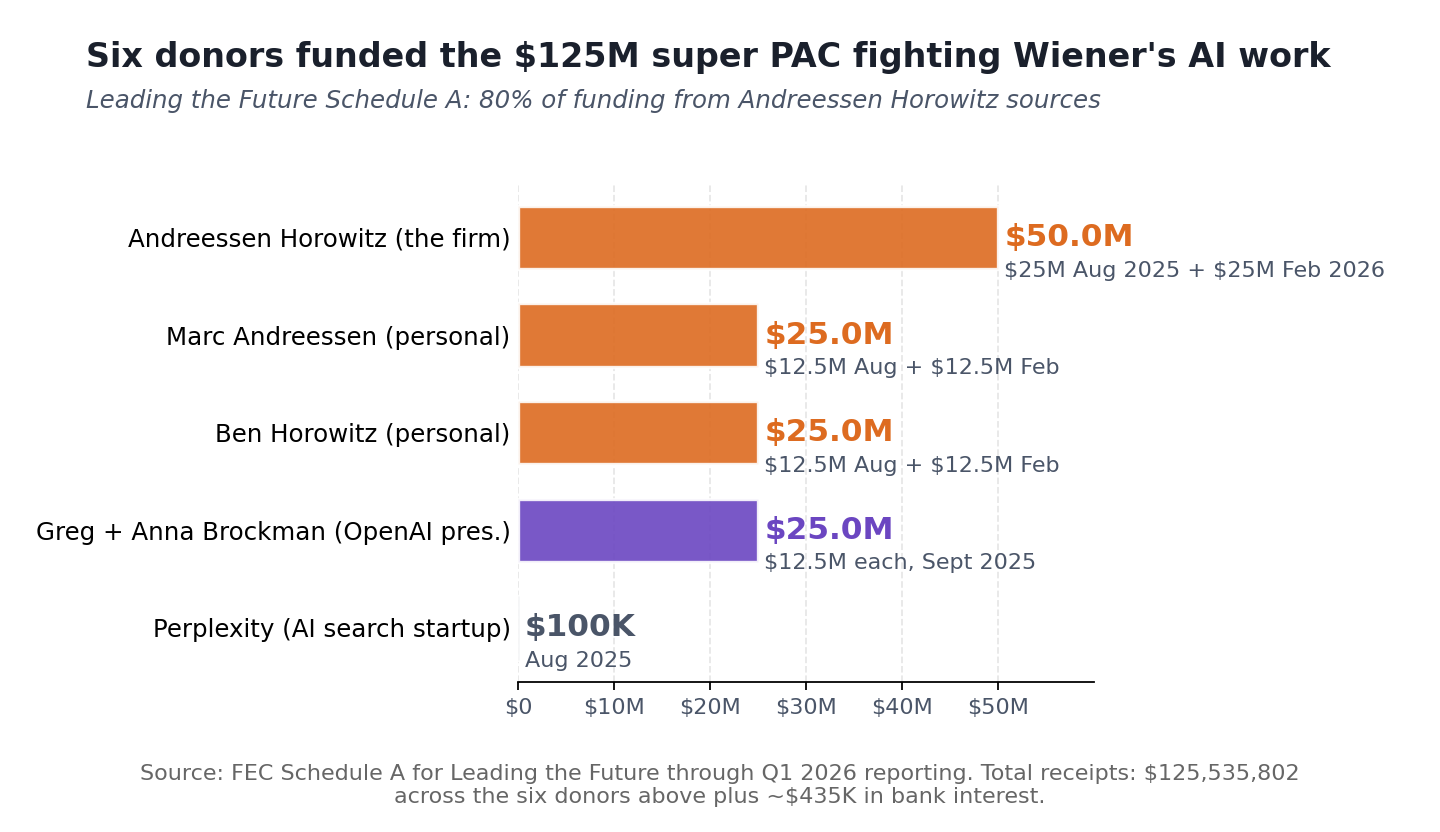
Google, Meta, and OpenAI opposed SB 1047 during the 2024 California fight, arguing it would stifle AI development. They all share an accelerationist worldview: build AI as fast as possible, and treat any regulation that slows it as a tax on progress.
How does Wiener differ from Chakrabarti and Chan on AI Safety?
Wiener is not the only candidate in this race with an AI platform. Saikat Chakrabarti supports the AI Data Center Moratorium Act, introduced by Senator Bernie Sanders and Representative Alexandria Ocasio-Cortez, which would pause new AI data center construction until federal policy addresses workforce displacement, energy use, and other harms.
The AI Safety coalition is choosing Wiener over Chakrabarti because Chakrabarti's proposed moratorium would functionally halt frontier AI development, which is something the coalition's funders genuinely oppose. The coalition also supports Wiener because he has actually authored frontier AI safety legislation (SB 1047 and SB 53). Chakrabarti has never held elected office and has no authored legislation. Chan, as an SF supervisor, co-sponsored a local AI inventory ordinance requiring city departments to disclose their AI use, but has not engaged with frontier AI regulation at the state or federal level.
Wiener's professional SF base
Wiener has a local constituency going back fifteen years, to his election as SF Supervisor for District 8 in 2010 and his move to the California State Senate in 2016. It includes tech employees, lawyers, designers, doctors at UCSF, nonprofit executives, and the LGBTQ+ community.
I mapped out the data by zip code from Scott Wiener for Congress's FEC filings through the May 21 pre-primary report. He has dramatically deeper in-city support than anyone else in the race: $407,000 from 248 donors in ZIP 94114 (Castro, Noe Valley, Duboce Triangle), against Chakrabarti's $21,000 from 90 donors in the same ZIP. Across SF proper, Wiener has raised about $1.94 million from 1,182 unique donors. Chakrabarti has raised about $88,000 from 815 SF donors (excluding roughly $10 million he has self-funded).
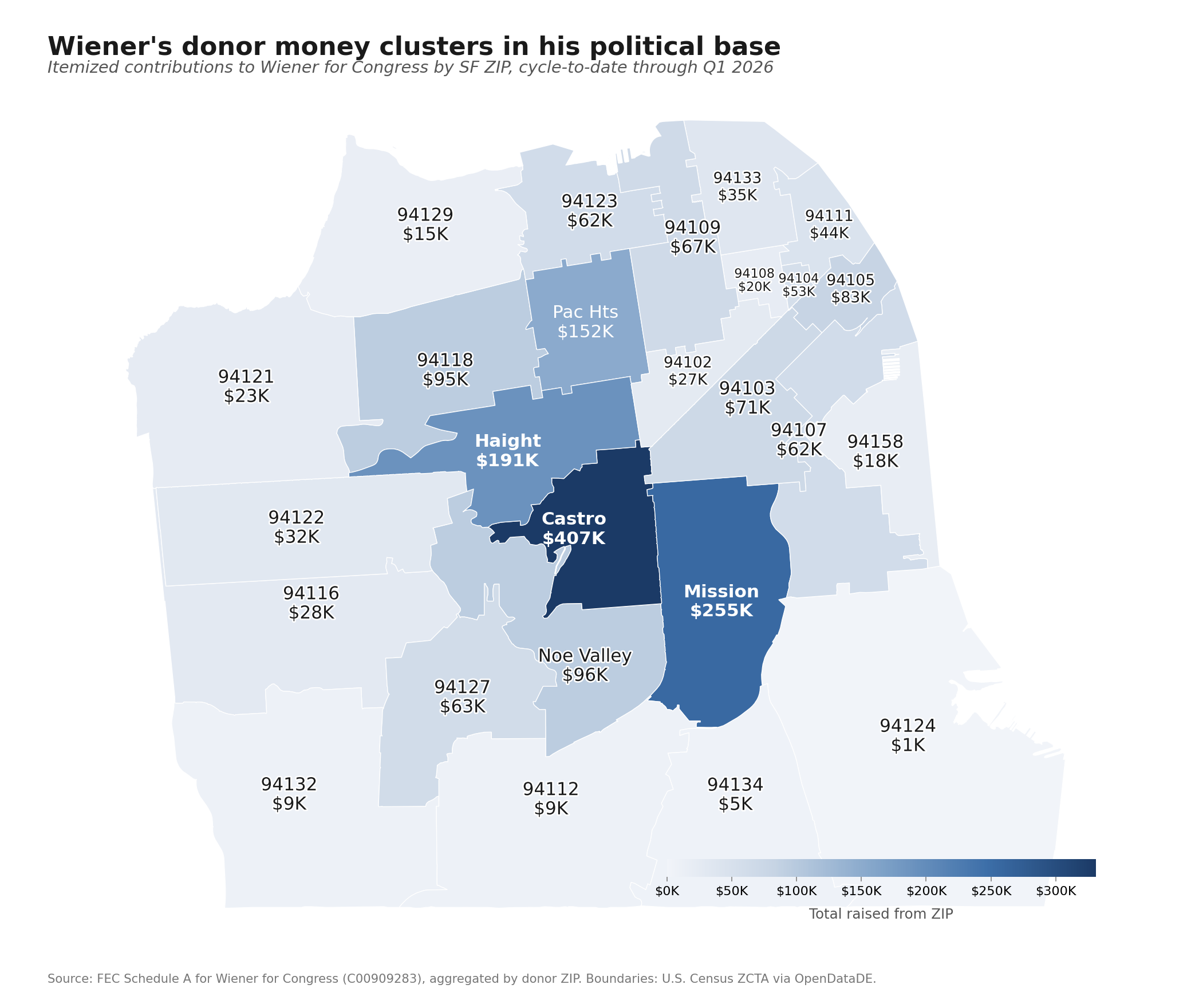
This is a professional, politically engaged base. Roughly 72 percent of Wiener's itemized money comes from gifts of $2,000 or more, the kind of donation a senior tech worker, lawyer, or doctor can write without it changing their lifestyle. It's well below philanthropist territory ($25K+ foundation-scale giving), but well above small-dollar grassroots. The people paying for Wiener's career are professionals with disposable income who choose to give politically, repeatedly, to the legislator they've trusted for fifteen years.
What Wiener's SF base supports
1. His fifteen-year LGBTQ legislative record. Wiener has been an openly gay legislator since his SF supervisor days representing District 8. His LGBTQ work is the densest part of his career and the main reason the Castro base has stayed with him for fifteen years.
| Bill | What it did |
|---|---|
| SB 145 (2020) | Equalized sex-offender registry treatment for consensual same-sex and opposite-sex conduct |
| SB 132 (2020) | Allowed transgender prisoners to be housed by gender identity |
| SB 107 (2022) | Made California a sanctuary state for gender-affirming medical care for trans youth |
| PrEP-access laws | Made HIV prevention medication available over the counter and required insurance coverage |
He has also championed abortion access (sanctuary-state legislation, expanded coverage) and drug-policy reform (cannabis legislation and the supervised consumption sites Newsom vetoed).
2. His housing and transit record. Wiener is one of California's most prolific YIMBY legislators and chairs the Senate Select Committee on Bay Area Public Transit.
| Bill | What it did |
|---|---|
| SB 35 (2017) | Streamlined approval for affordable housing in cities behind on housing targets |
| SB 828 (2018) | Reformed the Regional Housing Needs Assessment (RHNA) process so cities couldn't lowball housing allocations |
| SB 50 (2020) | Statewide upzoning near transit (died after coordinated opposition) |
| SB 423 (2023) | Renewed and expanded SB 35 |
| SB 79 (2025) | Legalized multi-family housing near rail and rapid bus stops (signed October 2025) |
| SB 63 (2025) | Connect Bay Area Act, authorizing a regional sales-tax measure on the November 2026 ballot to fund BART, MUNI, Caltrain, and AC Transit |
Stronger local transit funding also strengthens the case for federal infrastructure dollars on projects like the Geary Subway, which I covered in an earlier FoglineSF piece.
3. His broader federal tech platform. This base is heavily made up of tech-industry workers and professionals in adjacent fields who would see Wiener's broader federal tech agenda as directly relevant. Beyond the AI Safety legislation covered earlier, that agenda includes:
| Proposal | Details |
|---|---|
| Data privacy law | Federal version |
| Net neutrality | Federal extension of his California SB 822 (2017) |
| Algorithm transparency | Social media mandates with user opt-out |
| Deepfake disclosure | Federal disclosure requirements |
| AI tax | On AI companies and on industries using AI to grow profits |
| BASED Act (federal) | Federalized version of his SB 1074, banning trillion-dollar-market-cap platforms from self-preferencing their own products |
Mission Local's writeup goes deeper on the platform, and the underlying platform document has the full text.
Why does this base prefer Wiener over Chakrabarti and Chan?
The professional, politically engaged class that funds Wiener is the same demographic that elected Daniel Lurie mayor in 2024 and recalled progressive District Attorney Chesa Boudin and several school board members in 2022, and consistently backs the moderate Democratic faction across SF politics. They overlap heavily with the Abundance coalition operating federally through Abundant Future and locally through Abundant SF, which Zack Rosen and Todd David organized as a "tech families" donor table in 2023 with Wiener as its self-described "North Star."
Chakrabarti and Chan both sit further to the left. Chakrabarti's politics descend from the Sanders / AOC / Justice Democrats wing and lean toward structural change. Chan, while more establishment-Democrat, has voted against several Wiener-authored state housing bills and frames her housing politics around anti-displacement rather than supply-side production.
Wiener's anti-wealth-tax alignment
Two 2026 California tax measures targeting concentrated wealth have drawn major opposition from tech executives. On the June 2 ballot, San Francisco's Proposition D (the "Overpaid CEO Tax") would raise corporate tax rates on companies with 1,000+ employees and $1B+ revenue whose top executive earns 100 times or more their median worker. On the November 3 ballot, the statewide Billionaire Tax Act would impose a one-time 5 percent tax on California residents with more than $1 billion in net worth.
Wiener opposes both. He announced opposition to Prop D in April 2026, citing concern about disrupting Mayor Lurie's economic recovery agenda. He opposed the Billionaire Tax Act in May 2026 after it qualified for the ballot, calling California's revenue system "unstable" and the one-time-tax approach wrong. SEIU California withdrew its endorsement of Wiener over his tax position in April 2026, the most significant SF labor break from a longtime ally in this race.
His primary opponents are on the other side. Chakrabarti supports the Billionaire Tax and has personally donated $600,000 to support Prop D, the same measure Sergey Brin is spending $500,000 to defeat. Chan supports both measures.
On Wiener's side of the fight, the centerpiece donor is Chris Larsen. The Ripple co-founder has spent roughly $13 million opposing California's wealth-tax measures while contributing $100,000 to Abundant Future and maxing out personal contributions to Wiener's campaign. That is more than 100 times more on anti-tax fights than on Wiener's race. Garry Tan (Y Combinator CEO) and Jeremy Stoppelman (Yelp CEO), also Wiener donors, are smaller examples of the same overlap.
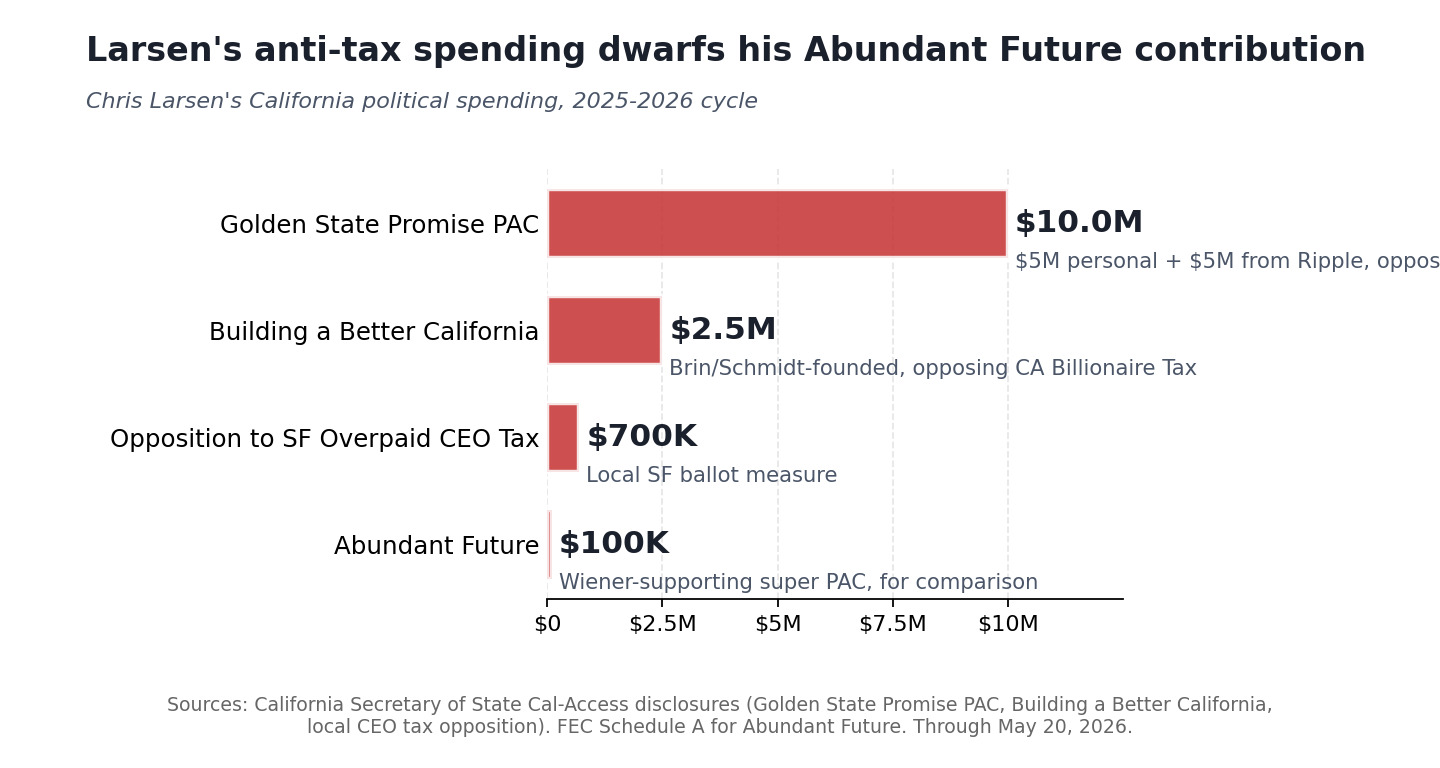
Larsen, Tan, and Stoppelman are part of a broader tech-executive movement that has raised more than $115 million across Building a Better California, the California Business Roundtable Issue PAC, and the Golden State Promise PAC.
Do you want what they want?
The tech money behind Wiener is both more diverse and more interconnected than the monolithic frame allows. A vote for Wiener buys pragmatic moderate-Democratic legislation, YIMBY housing, federal AI safety regulation, opposition to new wealth taxes, and continuity of his LGBTQ+ leadership. A vote for Chakrabarti or Chan buys versions of the progressive alternatives. "Tech money" as a label is too simplistic because it tells you nothing about what these donors want. The real question is whether what they want lines up with what you want.