Fogline · SF Civic Data
What's next for the Geary Subway?
Geary rail has been studied since the 1930s, but nothing has been built. Will it be different this time?
In February 2026, SFCTA released an updated Geary/19th Avenue Subway study evaluating corridor alignment options, technology choices, ridership scenarios, and project cost. SFCTA presented the study at town halls in March to gather community feedback. The Final Report comes to the SFCTA Community Advisory Committee on May 27 as an action item, then to the SFCTA Board in June, which will vote on whether to advance the project into formal design and federal funding application work.
I live a couple blocks off Geary and rely on the bus to get to places like The Fillmore, Japantown, Kaiser, and downtown. I even rode the bus to City Hall for today's SFCTA meeting. I'm naturally interested in anything that might help me get where I'm going faster and more efficiently.
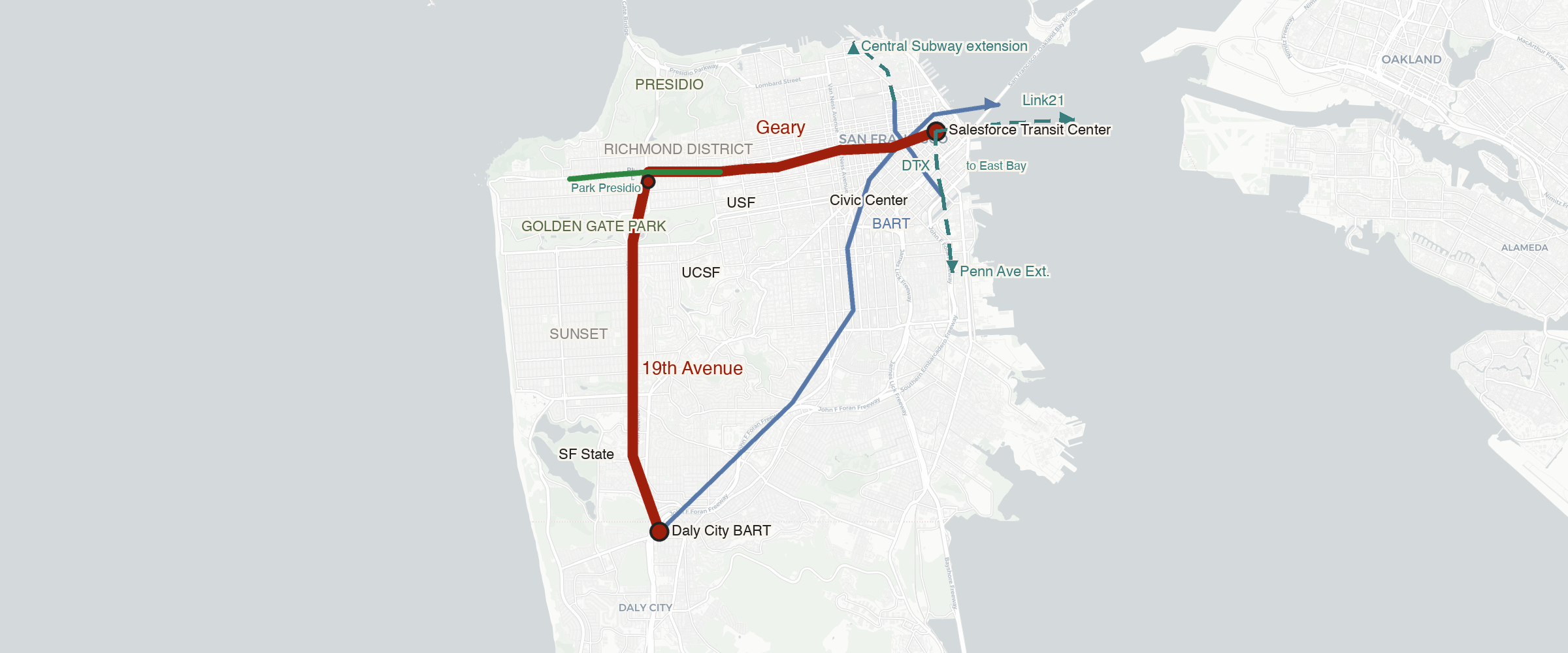
Open the interactive 3D map → Combines the subway corridor with the Family Zoning Plan parcels along it. Pan, zoom, tilt, click features for context.
A brief history of Geary rail proposals
This is not the first time Geary has been studied for rail. It's been studied since before most of us were born, yet we're still waiting.
In July 1935, two New York transit engineers, Robert Ridgway and Alfred Brahdy, filed a report to the SF Public Utilities Commission proposing a 2.5-mile subway under Geary. In May 1936, SFPUC Manager of Utilities Edward G. Cahill formalized the framework in a comprehensive report covering Market, Mission, and Geary subway alignments. A November 1937 bond measure to fund the system was defeated.
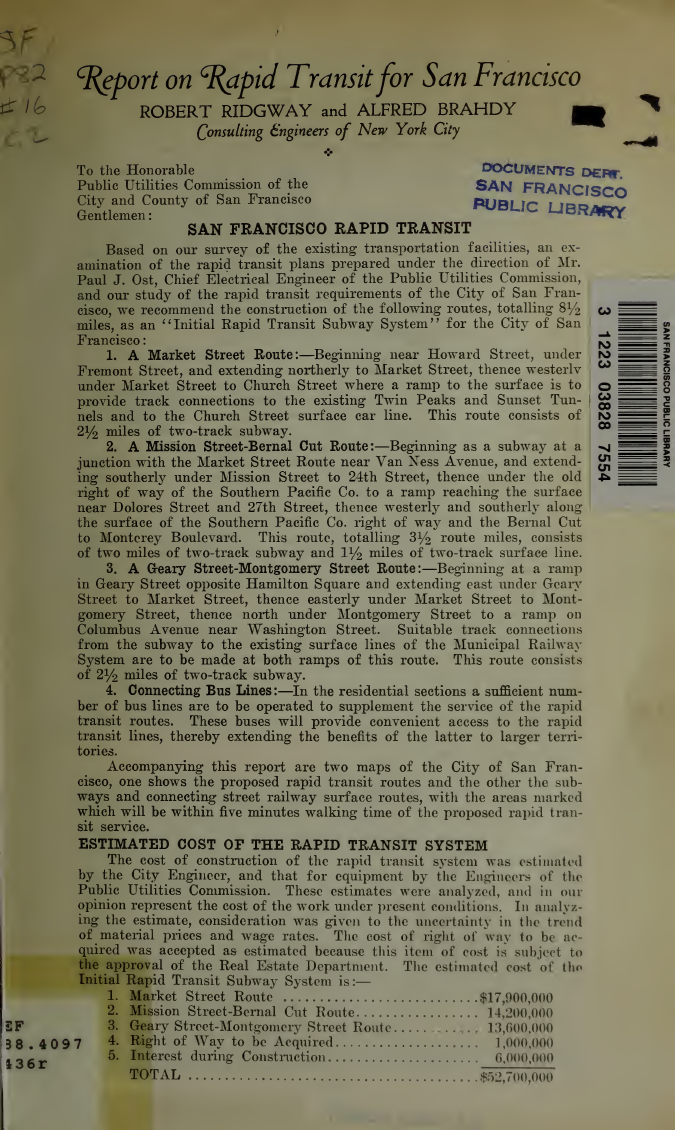
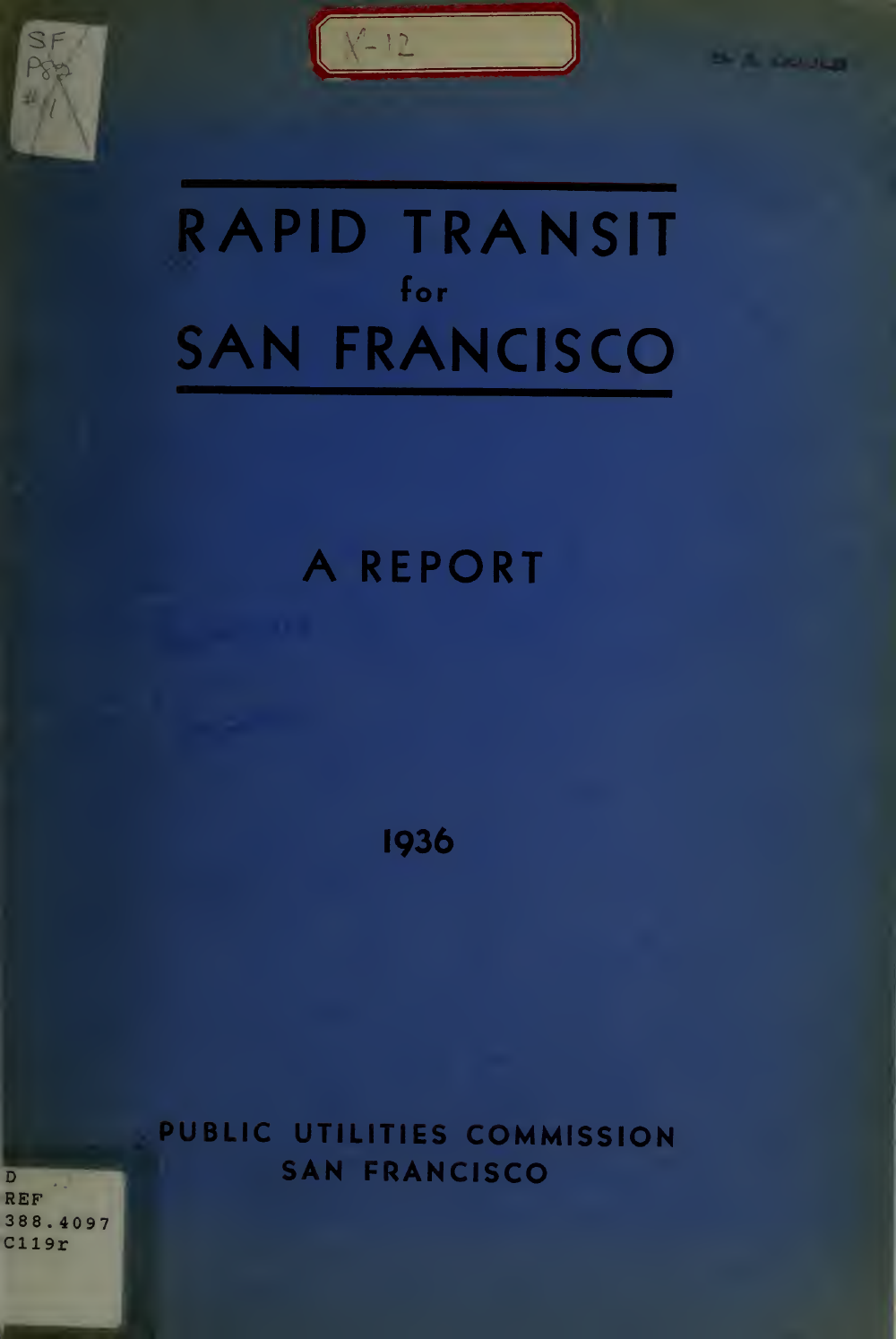
The corridor has come up roughly every generation since. The 1962 BART plan included a Geary line, but it died when Marin and San Mateo withdrew. SF voters approved Prop B in 1989, naming Geary as a priority transit corridor. Voters approved Prop K in 2003, funding bus rapid transit (BRT) on Geary "designed and built to rail-ready standards," plus a separate $55 million Geary Light Rail line item designated as Priority 3.
BRT Phase 1 opened in 2021. Near Geary and Divisadero, you can see it is essentially a red painted curb lane. Nothing changed with the center median, the trees, or the street parking.
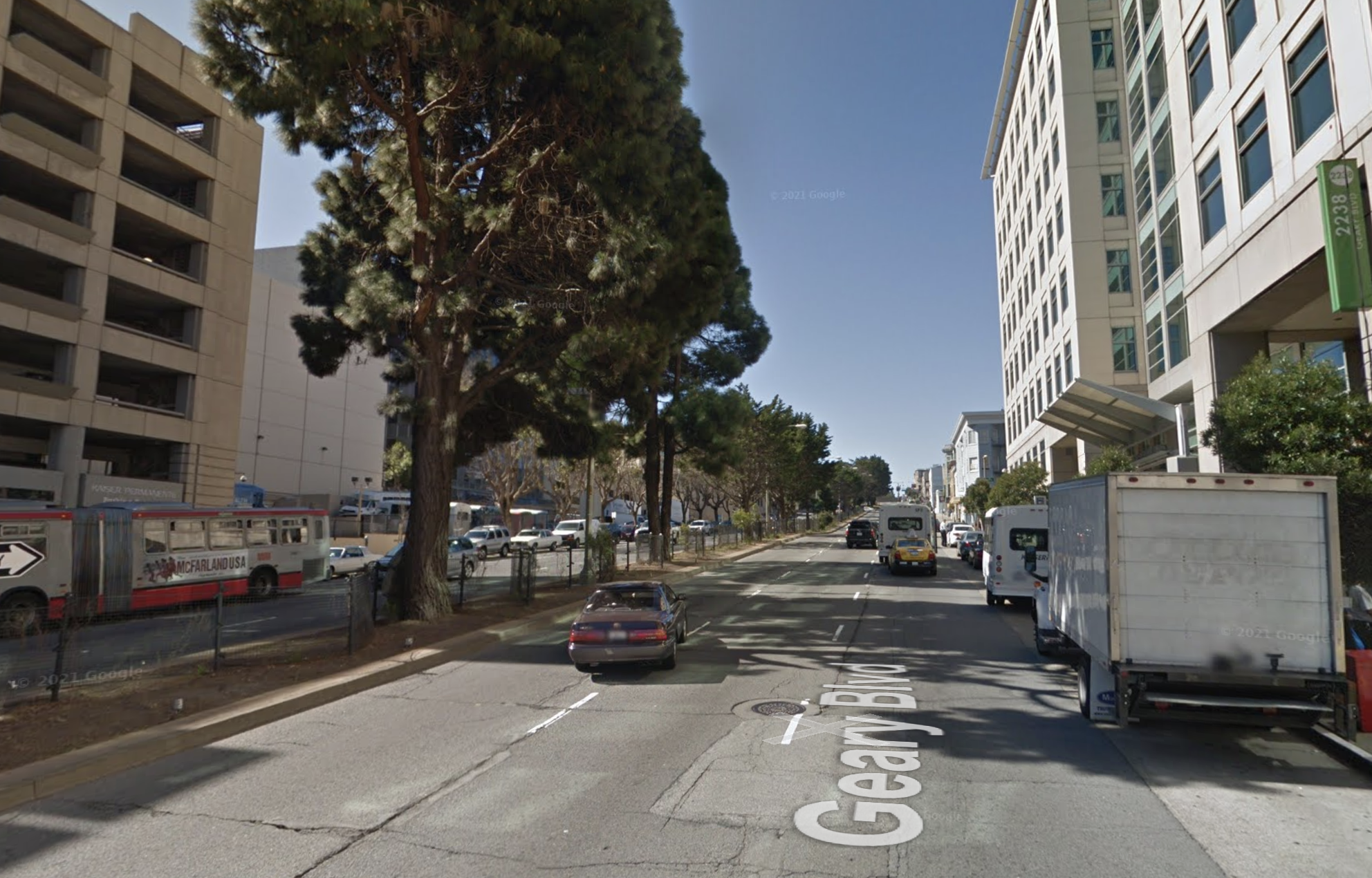
2015 — before BRT
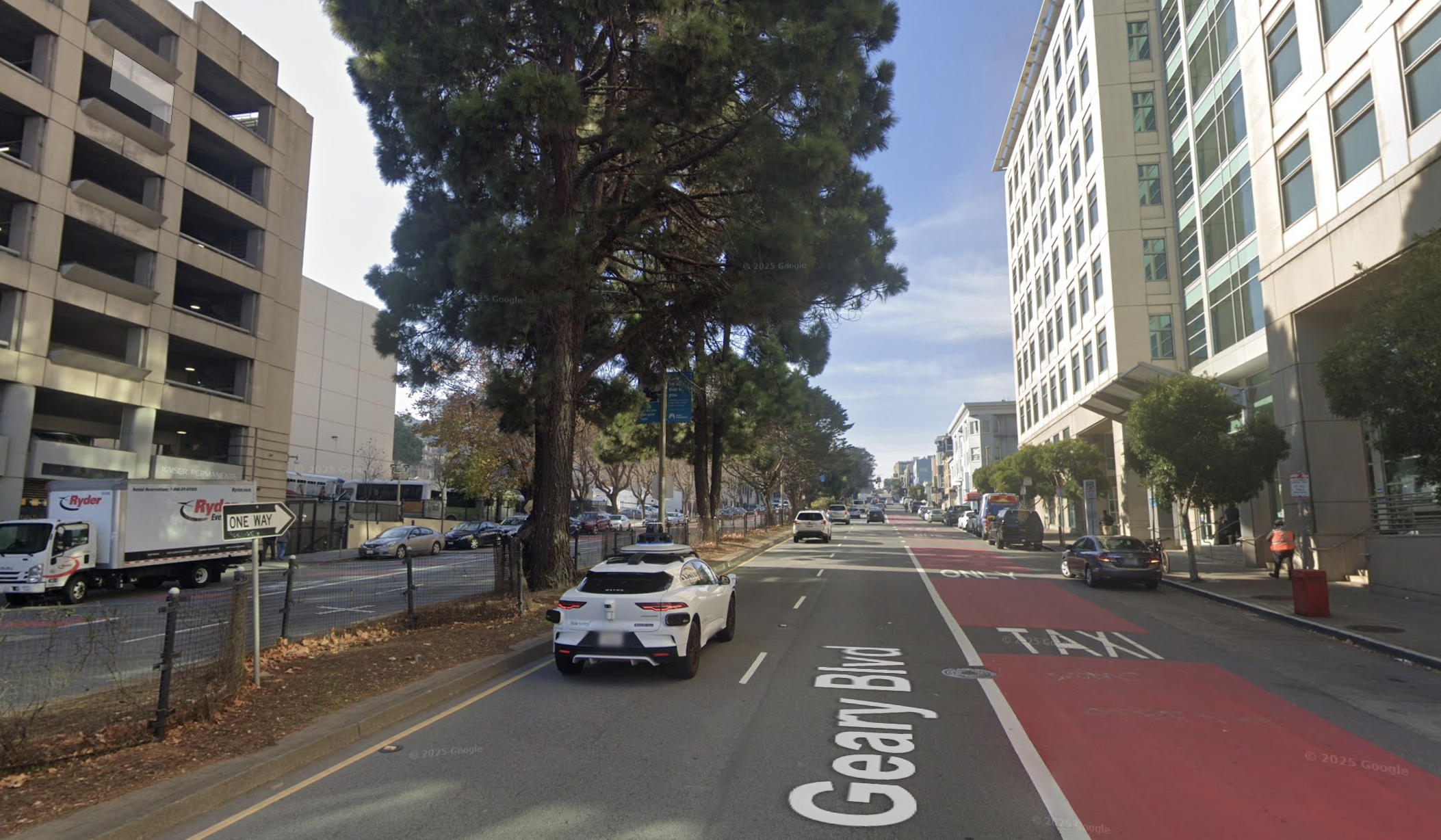
2022 — with BRT
Rail-ready was supposed to mean doing the expensive underground work once: the heavy roadwork, the utility relocation, and the center-running alignment a future light rail line would need, so the city wouldn't have to tear up Geary twice.
BRT Phase 2 was downgraded from center-running to side-running the same year, and the "rail-ready" mandate is no longer in Prop L, the 2022 sales-tax renewal.
Looking down at Geary from above: same six lanes in both designs, but the bus lanes sit in different positions, and you board in different places.
Side-running BRT
Built on Geary today
Center-running BRT
The rail-ready alternative, dropped in 2021
Graphic: FoglineSF.com
The full timeline
- 1935-36 Ridgway-Brahdy and Cahill reports to the SFPUC propose Market, Mission, and Geary subway alignments. Never funded.
- 1962 Original BART plan included a Geary line, then dropped after Marin and San Mateo withdrew.
- Nov 1989 SF voters pass Prop B, naming Geary as a priority transit corridor.
- Nov 2003 SF voters pass Prop K: BRT "rail-ready" mandate plus a separate $55M Geary Light Rail line item (Priority 3, MUNI as sponsoring agency).
- Jan 2017 SFCTA Board certifies the hybrid BRT Final Environmental Impact Report (EIR): center-running in the Richmond, side-running east of Stanyan.
- 2021 BRT Phase 1 (Market to Stanyan) opens as side-running, as specified in the 2017 EIR.
- Nov 2021 BRT Phase 2 (west of Stanyan) downgraded from center-running to side-running.
- Dec 2021 ConnectSF Transit Strategy published (SFCTA, SFMTA, SF Planning). On Dec 7, SFCTA Board approves Resolution 22-16, creating a new "Geary-19th Avenue Corridor Rail Strategy and Planning" line item at $3.5M.
- Apr 2022 Supervisor Myrna Melgar's SFCTA Board request funds the Strategic Case ($802K Prop K, Item 9).
- Nov 2022 Voters approve Prop L, renewing the sales tax for 30 years. The "rail-ready" mandate is gone. Geary becomes one of four eligible projects in a $27M Next Gen Transit Investments line.
- Feb 25, 2026 SFCTA presents the interim Geary/19th Avenue Subway Study Update to its Community Advisory Committee. Cost $20-30B. Ridership 160-180k SF-only / up to 310k regional.
- Spring 2026 Final report expected at the CAC and the SFCTA Board. Board votes on whether to authorize the next planning phase.
Graphic: FoglineSF.com
How the current proposal came together
In December 2021, SFCTA, SFMTA, and SF Planning jointly published the multi-agency ConnectSF Transit Strategy. The Strategy was the first SF planning document in decades to put a Geary subway on the map as a long-range vision rather than another BRT iteration.
That same month, SFCTA staff created a new ~$3.5M planning line item for Geary subway work via a routine Prop K Strategic Plan amendment (Resolution 22-16).
On April 12, 2022, Supervisor Myrna Melgar (D7) requested a Strategic Case for the subway. The SFCTA Board approved $802K in Prop K funds for the scoping work that day, with an expected mid-2023 delivery. The interim update reached the CAC in February 2026, about three years late.
In November 2022, voters approved Prop L, renewing the half-cent transportation sales tax for 30 years. The Expenditure Plan included a $27 million "Next Generation Transit Investments" line for which the Geary subway is one of four eligible projects, alongside the Central Subway extension, Link21, and regional express bus.
In 2024, Caltrans published the California State Rail Plan, which identified standard-gauge rail in Western San Francisco as a key connection for the regional and state network (the plan states that "standard gauge rail in Western San Francisco" would deliver significant ridership increases for both the region and the state). In June 2025, the BART Board and the CCJPA Board selected standard gauge for the Link21 program, the planned second transbay rail link. A standard-gauge link is what would allow Caltrain, future high-speed rail, and a possible Geary heavy-rail line to share infrastructure.
Where it stands now
On February 25, 2026, SFCTA staff presented an interim update of the Geary/19th Avenue Subway Study to the SFCTA Community Advisory Committee. The deck previewed findings. The final report will be presented to both the CAC and the Board this spring. The headline numbers from the interim:
The $20-30B range reflects planning-phase uncertainty (no alignment, technology, or station list has been fixed) plus the realities of SF construction: tunneling under a densely-built corridor, seismic engineering requirements, and decade-plus inflation horizons.
What's different this time?
The east-west Geary subway concept itself isn't new. Engineers have proposed roughly the same alignment every generation since the 1930s. The 38 Geary is still SF's highest-ridership bus route, just as the corridor was congested when Ridgway and Brahdy filed their report in 1935. What's actually new is the framing around it.
| Prior proposals | Current iteration | |
|---|---|---|
| Corridor | Geary only | L-shaped (Geary + 19th Avenue) |
| Eastern terminus | Market/Powell | Salesforce Transit Center |
| Scope | SF-only subway | Regional rail integration (Link21) |
| Technology | Streetcar (1935-36), BART-gauge (1956-62), light rail (2003) | Standard-gauge regional rail (other options still open) |
| Cost | Millions to low billions | $20-30B |
The corridor is L-shaped. The 19th Avenue corridor (south from Park Presidio through the Sunset to Daly City BART) was studied separately over the decades, never as part of a Geary subway. Combining the two into a single L-shaped alignment shows up first in the 2021 ConnectSF Transit Strategy and got formalized in Melgar's 2022 Strategic Case.
The eastern terminus is Salesforce Transit Center, not Market Street. Older proposals connected at Market & Powell. Tying the eastern end to the regional rail hub at Salesforce TC is a new design choice that depends on DTX/The Portal (the Caltrain extension to Salesforce) eventually getting built.
The project is regional rail, not an SF-only subway. The 310,000-rider regional scenario depends on the Link21 standard-gauge transbay tube. The California State Rail Plan's 2024 mention of "standard gauge rail in Western San Francisco" is the explicit state-level recognition. The June 2025 BART/CCJPA standard-gauge decision is what makes the integration possible.
Standard-gauge regional rail is on the table as a technology option. Standard-gauge is the new option enabled by Link21's June 2025 decision, the one that allows Caltrain, future high-speed rail, and a Geary heavy-rail line to share infrastructure. But the Feb 2026 deck explicitly keeps all technology options open, including BART-gauge and automated light metro. Transit advocates have argued that an automated light metro (similar to Vancouver's SkyTrain) would be cheaper and allow higher frequencies. The technology choice is still a live decision.
| Standard gauge | BART (broad) gauge | Automated light metro | |
|---|---|---|---|
| Track width | 4'8.5" | 5'6" | Standard (4'8.5") |
| Examples | Caltrain, future CA HSR, Link21 | BART (Bay Area only) | Vancouver SkyTrain, Honolulu Skyline |
| If chosen for Geary | Could share infrastructure with Caltrain, HSR, and a future Link21 transbay link | Would extend the BART network | Would be SF-only (no interchange with other regional rail) |
| Frequency | Lower (intercity scale) | Moderate | Very high (driverless) |
| Relative cost per mile | Higher | Higher | Lower (typically) |
The cost is much larger, and the funding framework depends on value capture. $20-30B is well beyond any prior Geary estimate. The funding strategy explicitly contemplates capturing some of the land value created along the corridor by the Family Zoning Plan upzoning, density that earlier Geary proposals didn't have.
Where do we get $20-30B from?
SFCTA's own February 2026 deck (slide 23) states that "existing sources are not enough to fund the project." Filling that gap is the central work of the funding plan, and as of May 2026 the plan is mostly a sketch of possible mechanisms rather than a model.
Graphic: FoglineSF.com
Each funding source runs through a different body. Federal CIG flows through the FTA, but only if the project appears in Plan Bay Area, the long-range regional plan jointly produced by MTC (transportation) and ABAG (housing and land use) for the 9-county Bay Area.
The largest single source is federal. Comparable subway projects typically draw 35-50% of capital cost from the FTA Capital Investment Grants (CIG) program. For Geary, that would mean $7-15 billion.
The federal pipeline is a moving target. Since the second Trump administration took office in January 2025, FTA has not processed any new CIG awards. In July 2025, USDOT terminated $4.2 billion in committed federal funding from the California High-Speed Rail Authority via a Federal Railroad Administration "Compliance Review." This is a significant federal defunding of a US transit megaproject and sets the precedent for what a hostile administration can do to a California rail project. The Geary subway's eventual CIG application would be submitted in 2027-2029.
Value capture is assumed but not modeled. New dense real estate developments along Geary would help pay for the subway that makes their land more valuable, through some combination of taxes, fees, or assessment districts. The 2025 Family Zoning Plan upzoning is what produces that density.
The November 2026 ballot measures. Stable funding for SFMTA's day-to-day operations strengthens the case for federal money. CIG scoring rates the project sponsor's existing-system health (the "Local Financial Commitment" criterion) alongside the new-project funding plan, so an SFMTA in service retrenchment scores worse.
Objections to the project
Voters have funded Geary transit improvements multiple times since 1989. Still, the current subway proposal raises a few objections worth taking seriously.
Construction disruption could last more than a decade. A subway construction window of 10+ years would dwarf the disruption merchants have already documented during the current BRT and SFPUC work (the August 2023 small-business funeral protest is the corridor's most recent reminder). Whether the agency has a credible mitigation plan, particularly for parcel-fronting-Geary businesses, is a reasonable corridor-resident concern.
"Let's work together," yeah right https://t.co/zvwGtO3KN1
— Anthony Lazarus (@Sr_Lazarus) September 19, 2024
It's still unclear how the project gets paid for. SFCTA's February 2026 deck says existing sources are not enough. Value capture is one mechanism being considered, but California's largest precedent (the Transbay Transit Center) is an order of magnitude smaller than what Geary would need. No specific funding plan has been published as of spring 2026.
Subway dollars could go to fixing today's Muni instead. SFMTA is in a structural operating deficit. Some readers will reasonably weigh long-horizon subway investment against fixing the 38 Geary, the rest of Muni, and BART today.
Mobility technology is advancing faster than the project timeline. A subway opening in the 2040s enters a mobility landscape very different from today's. Waymo is already operating commercially in SF, and autonomous ride-hail at scale could substantially shift the assumptions about transit ridership and mode share that the current study models.
What happens between now and November
There are three important decisions coming up between now and November 2026. The SFCTA Community Advisory Committee reviews the study and makes a recommendation, the SFCTA Board votes on next-phase authorization in June, and voters decide on two ballot measures in November.
The two November measures are the regional Connect Bay Area sales tax (~$1B/year regionally) and the SF Stronger Muni for All parcel tax (SF-only, ~$166M/year). Both still need to qualify via citizen petition by early summer. Both fund SFMTA operations, not the Geary subway directly.
These measures will shape the Geary subway's federal funding case. Federal Capital Investment Grant scoring evaluates the project sponsor's existing-system health (the Local Financial Commitment criterion). An SFMTA in service retrenchment scores worse, which weakens any future federal CIG application for the Geary subway. If the November measures pass, they strengthen the federal funding case for the Geary subway. If they fail or don't qualify, they weaken it.
The subway is closer to reality than it has been in decades. It's also still decades from any plausible revenue service, and 90 years of history says the plan tends to get downgraded between approval and delivery. The coming months determine whether this iteration breaks the pattern or becomes the latest in a long line of failed Geary rail proposals on a future blogger's historical timeline.